Clinically reviewed by Clint Kreider, MS, LMFT, Clinical Director at Harmony Junction Recovery. · Reviewed November 2026
Short answer: Meth (methamphetamine) can usually be detected in urine for about 1–4 days after last use, and up to about a week after heavy, frequent use. Blood tests pick it up for up to 1–3 days (often only about 24 hours), saliva tests for up to 1–2 days, and hair tests for up to 90 days. The high wears off long before the drug clears: meth’s half-life averages around 10–12 hours, so it takes a few days for the body to eliminate it.
Meth detection times by test
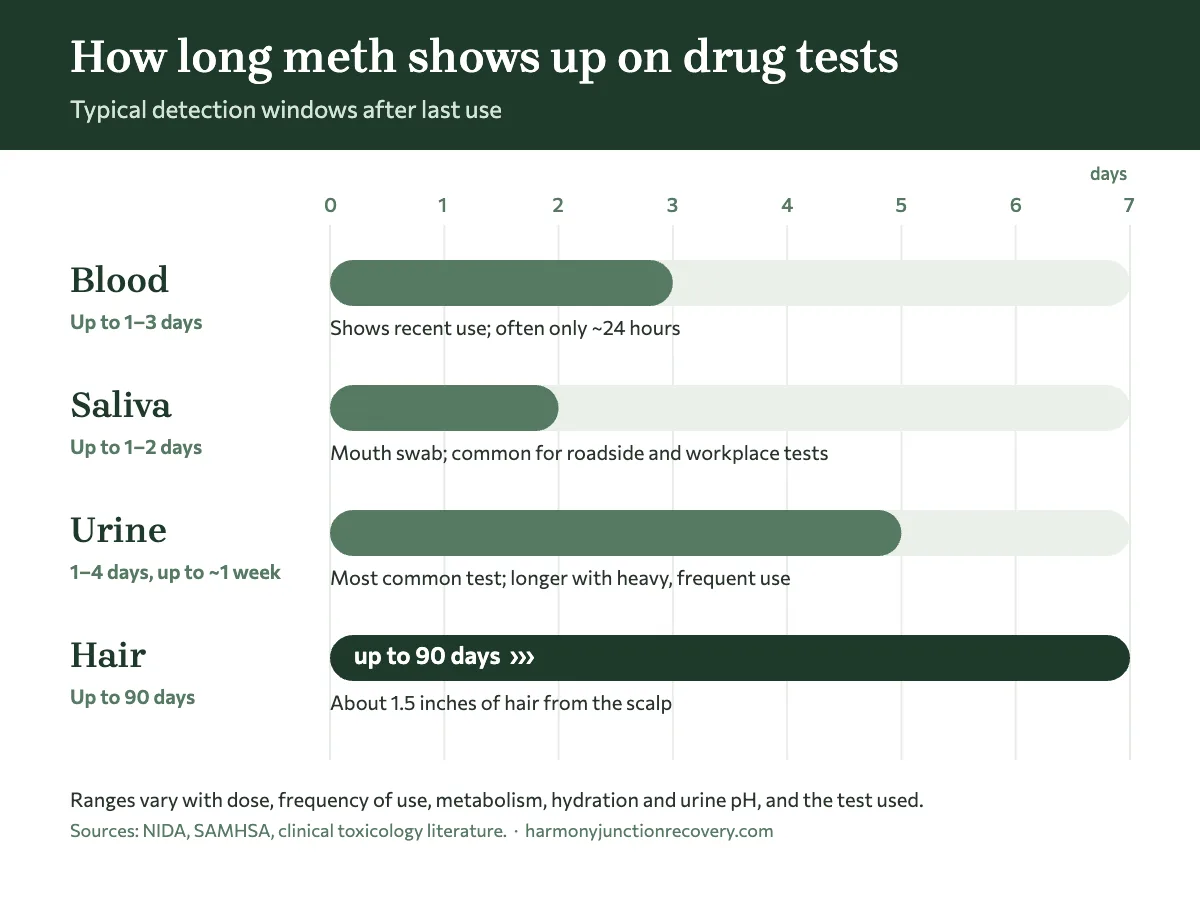
| Test | Typical detection window | Notes |
|---|---|---|
| Urine | 1–4 days; up to about 1 week with heavy use | The most common test. Usually shows up within a few hours of use |
| Blood | Up to 1–3 days (often about 24 hours) | Mostly used in hospitals and after accidents; shows recent use |
| Saliva (mouth swab) | Up to 1–2 days | Common for workplace and roadside testing |
| Hair | Up to 90 days | A 1.5-inch sample of scalp hair covers about 3 months; doesn’t show use from the last week or so |
These are typical ranges, not guarantees. Detection depends on the person, how they used, and the test and cutoff level used by the lab.
How long does a meth high last?
The intense rush from smoking or injecting meth lasts only minutes, but the overall high can last anywhere from about 8 to 24 hours. Because meth stays active so much longer than cocaine, people often go days without sleeping or eating during a binge. That is followed by a “crash” of exhaustion and low mood, which is the start of meth withdrawal.
What affects how long meth stays in your system
- How much and how often you use: daily or binge use builds up in the body and extends detection times
- How it was taken: smoking, injecting, snorting or swallowing change how quickly it peaks and clears
- Urine pH: meth leaves the body faster in acidic urine and more slowly in alkaline urine
- Metabolism, age and body composition
- Kidney and liver function: both help break down and remove the drug
- The test itself: labs use different cutoff levels, and confirmation tests are more sensitive than quick screens
How meth shows up on a drug test
The body breaks methamphetamine down partly into amphetamine, and a large share leaves unchanged in urine. Standard drug panels screen for the “amphetamines” class, so meth use usually tests positive for both methamphetamine and amphetamine. A positive screen is normally sent for a confirmation test (such as GC-MS or LC-MS), which identifies the exact substance.
Can anything cause a false positive for meth?
Quick immunoassay screens can sometimes react to other substances, including some decongestants (such as pseudoephedrine), certain antidepressants and blood pressure medications, and over-the-counter nasal inhalers that contain levomethamphetamine. Confirmation testing can tell these apart from illicit meth. Prescription stimulants such as Adderall show up as amphetamine; prescribed methamphetamine (Desoxyn) will test positive for meth. If you take any prescription medication, tell the testing lab or the medical review officer.
Can you flush meth out of your system?
No. There is no proven way to speed up how fast your body clears meth. Drinking large amounts of water can dilute urine, but labs check for diluted samples and may treat them as a failed or invalid test, and drinking too much water can be dangerous. Detox drinks and products are not reliable. The only way to pass a drug test for meth is time without using.
If you’re worried about a test because you can’t stop using, that is worth paying attention to. Meth use disorder is treatable.
Getting help for meth use
There are no FDA-approved medications specifically for meth addiction, but therapy works. Cognitive behavioral therapy (CBT) and contingency management have the strongest evidence for stimulant use disorders. Because meth often goes hand in hand with depression, anxiety or psychosis, dual diagnosis treatment that addresses both is important. Treatment usually starts with a safe, supported withdrawal, followed by residential treatment, PHP or IOP. See our meth detox and rehab program in Lake Forest.
Frequently asked questions
How long does meth stay in your urine?
Usually about 1–4 days after last use. With heavy, frequent use it can sometimes be detected for up to about a week.
Will one use of meth show up on a drug test?
Yes. A single use can usually be detected in urine for 1–3 days. Hair tests are better at picking up repeated use, but a single use can sometimes show up too.
How long does meth stay in your hair?
Standard hair tests look back about 90 days, using about 1.5 inches of hair closest to the scalp. Hair tests don’t detect very recent use, because it takes about a week for affected hair to grow out above the scalp.
Does insurance cover meth rehab?
Most PPO insurance plans cover medically necessary detox and treatment for stimulant use disorders. Check your coverage or call us for a free benefits check.
Ready to stop using meth? Our admissions team in Lake Forest is available 24/7 for a free, confidential assessment and insurance check. Call (855) 906-4088.
Sources: National Institute on Drug Abuse (NIDA), Methamphetamine Research Report; Substance Abuse and Mental Health Services Administration (SAMHSA), Clinical Drug Testing in Primary Care (TAP 32) and Treatment of Stimulant Use Disorders; Moeller et al., Clinical Interpretation of Urine Drug Tests, Mayo Clinic Proceedings.