Clinically reviewed by Clint Kreider, MS, LMFT, Clinical Director at Harmony Junction Recovery. · Reviewed November 2026
Short answer: You can’t force someone to stop drinking, but you can make treatment much more likely. Talk when they are sober, describe specific things you have seen and how they affect you, reward time spent sober, stop covering for the consequences of drinking, and have a concrete next step ready, such as an assessment or a medical detox, for the moment they say yes. Research on the family-based CRAFT approach shows this works better than confrontation. And don’t let them quit alcohol suddenly on their own if they drink heavily every day: alcohol withdrawal can cause seizures and needs medical care.
Signs your loved one may need help
You don’t need a diagnosis to act. Common signs that drinking has become a problem include:
- Losing control: drinking more or for longer than they meant to, or trying to cut back and failing
- Hiding or minimizing it: secret bottles, drinking before events, getting defensive when it comes up
- Consequences that don’t stop the drinking: missed work, arguments, a DUI, health warnings
- Tolerance: needing more to feel the same effect
- Withdrawal: shakiness, sweating, anxiety or poor sleep when they haven’t had a drink, or drinking in the morning to feel normal
- Giving things up: dropping hobbies, friends or family time in favor of drinking
For a fuller list, including the 11 criteria doctors use, see common behaviors of an alcoholic.
How to help an alcoholic: 5 steps that work
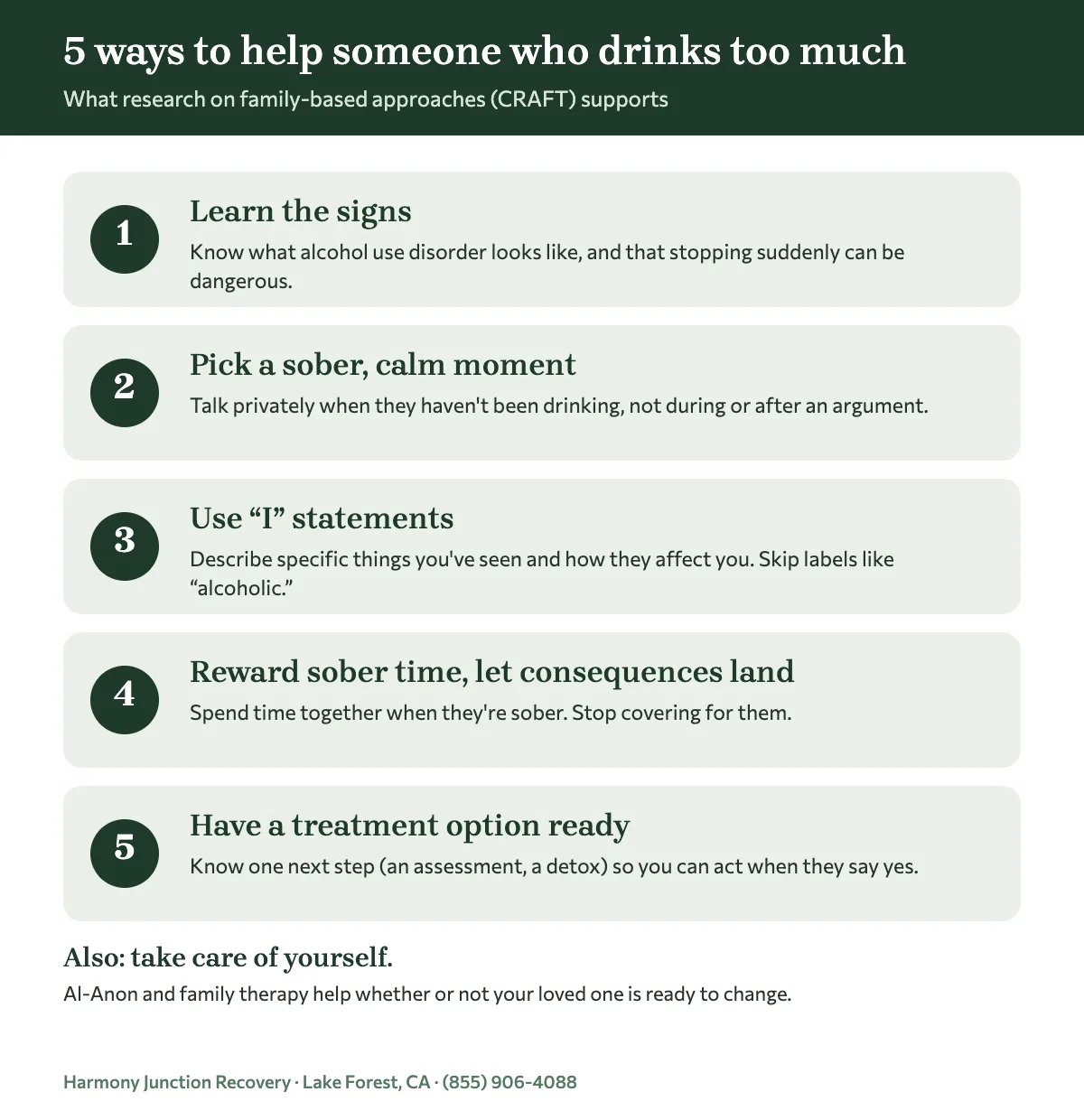
1. Learn about alcohol use disorder first
Alcohol use disorder is a medical condition, not a lack of willpower. Understanding that makes it easier to talk without blame. It also helps you spot danger: someone who drinks heavily every day can develop severe withdrawal, including seizures or delirium tremens (DTs), if they stop all at once. That is why the safest first step for heavy drinkers is usually a medically supervised alcohol detox, not quitting cold turkey at home.
2. Choose a calm, sober moment
Don’t start the conversation while they are drinking, hungover, or in the middle of an argument. Pick a private time when you are both calm. Keep it short and plan what you want to say.
3. Use “I” statements and specific examples
Describe what you have seen and how it affects you, rather than labeling them. For example:
- “I was scared when you drove home after the party on Saturday.”
- “I miss the evenings we used to spend together. Lately you’re asleep on the couch by eight.”
- “I love you, and I’m worried about how much you’ve been drinking.”
Words like “alcoholic” or “drunk” tend to trigger defensiveness. Then listen. If they deny there is a problem, you don’t need to win the argument today. You have planted a seed.
4. Reward sober time and let consequences happen
This is the heart of CRAFT (Community Reinforcement and Family Training), the best-studied approach for families. Make sober time rewarding: plan things you enjoy together when they haven’t been drinking. When they do drink, step back from the pleasant parts, and stop rescuing them from the results, such as calling in sick for them or cleaning up after a night of drinking. In studies, CRAFT got about two-thirds of resistant loved ones into treatment, compared with roughly one in four for a traditional confrontational intervention.
5. Have a treatment option ready
People often agree to get help in a brief window after a bad night or a scare. Be ready before that moment comes: know which programs your loved one’s insurance covers, and have a phone number in hand. A free assessment is a low-pressure first step. At Harmony Junction Recovery our admissions team can check insurance benefits and, if needed, arrange admission within a day or two.
What to avoid
- Confrontational “ambush” interventions: they can damage trust, and research shows they get fewer people into treatment than CRAFT
- Covering for them: making excuses to their boss, paying off drinking-related debts, hiding problems from family
- Lecturing, nagging or arguing when they’ve been drinking
- Threats you won’t follow through on: set boundaries you can keep, and keep them
- Drinking with them or keeping alcohol at home for them
- Pouring out bottles or forcing a sudden stop for someone who drinks heavily every day, because of the withdrawal risk
When it’s an emergency
Call 911 if your loved one has signs of alcohol poisoning or severe withdrawal:
- Confusion, or you can’t wake them
- Vomiting while very drunk or semi-conscious
- Slow or irregular breathing, or bluish or pale skin
- A seizure
- Hallucinations, severe shaking or agitation after they’ve stopped drinking
Don’t leave someone who is very drunk to “sleep it off” alone. Lay them on their side and stay with them until help arrives. If your loved one talks about suicide, call or text 988 any time.
What if they won’t get help?
Many people say no the first time, or the first several times. That doesn’t mean you’ve failed. Keep using the steps above, and keep the door open: “Whenever you’re ready, I’ll help you make the call.” Meanwhile, protect your own wellbeing:
- Get support for yourself: Al-Anon meetings, a therapist trained in CRAFT, or family therapy
- Keep yourself and any children safe: if there is violence or drunk driving, involve the appropriate authorities
- Use free help lines: the SAMHSA National Helpline (1-800-662-4357) is free, confidential and open 24/7
You can’t control someone else’s drinking, but taking care of yourself often changes the dynamic at home in ways that make treatment more likely.
What treatment for alcohol use disorder looks like
Treatment is matched to how severe the drinking is and what support the person has at home:
| Level of care | Who it’s for | Typical length |
|---|---|---|
| Medical detox | Daily heavy drinkers, or anyone with past withdrawal symptoms | About 3–7 days |
| Residential treatment | People who need a structured, alcohol-free setting to start recovery | About 30–90 days |
| Partial hospitalization (PHP) | Full-day treatment while living at home or in sober living | A few weeks |
| Intensive outpatient (IOP) | Several sessions a week around work and family | Often 8–12 weeks |
Medications such as naltrexone and acamprosate can reduce cravings and relapse. Families have a role too: see family involvement in rehab for how visits, calls and family therapy work. Learn more about our alcohol rehab program in Lake Forest.
Frequently asked questions
Can you force an alcoholic to go to rehab?
Generally, no. In California, involuntary holds or conservatorship are possible only in narrow, severe situations, such as when someone is gravely disabled, and they are a last resort. Encouragement works better anyway: family approaches like CRAFT get most loved ones into treatment voluntarily.
Should I stage an intervention?
Surprise, confrontational interventions are less effective than many people expect, and they can backfire. A planned, caring conversation using the CRAFT approach, ideally with guidance from a counselor, tends to work better.
Is it safe for someone to stop drinking cold turkey?
Not for everyone. People who drink heavily every day, or who have had shakes, hallucinations or seizures when they stopped before, should withdraw under medical supervision because alcohol withdrawal can be life-threatening.
Does insurance cover alcohol rehab?
Most PPO insurance plans cover medically necessary alcohol detox and treatment. Check coverage or call us for a free benefits check.
Worried about someone you love? Our admissions team in Lake Forest talks with families every day. Call (855) 906-4088 any time for free, confidential advice on next steps and a free insurance check.
Sources: National Institute on Alcohol Abuse and Alcoholism (NIAAA), Rethinking Drinking and Treatment for Alcohol Problems; Substance Abuse and Mental Health Services Administration (SAMHSA); American Psychological Association, Community Reinforcement and Family Training (CRAFT); Miller, Meyers & Tonigan (1999), Journal of Consulting and Clinical Psychology; Kirby et al. (2017), Psychology of Addictive Behaviors.